In two minutes
AI for HR: a short introduction
What you learn, and how you use it in your work the next day.
Courses for HR and recruitment
The courses for your field, plus the general ones that fit your work.

AI Fluency for HR & Recruitment Course
3 wk 8 hr/wk 24 hr
A 24-hour course for HR and recruitment professionals on the responsible use of AI in recruitment, development and HR policy, closing with an assessed final case.
Data Fluency for HR & Recruitment Course
3 wk 8 hr/wk 24 hr
A 24-hour course on the figures that steer HR and recruitment and on handling candidate and employee data within the GDPR, closing with an assessed final report on your own figures.

Prompt Engineering Course
3 wk 8 hr/wk 24 hr
Do you want to leverage AI tools to make your company future-proof? Discover how to enhance productivity, cut costs, and improve decision-making with the latest AI solutions.

AI Literacy & Ethics Course
3 wk 8 hr/wk 24 hr
Explore the ethical, legal, and social implications of AI including the EU AI Act. Learn to evaluate and design responsible AI strategies.
Two courses, made for HR and recruitment
Each course is online, taught in Dutch, with an assessed final assignment about your own practice.
AI Fluency for HR & Recruitment
What you learn:
- How large language models work and the mistakes they make structurally
- Which HR and recruitment tasks suit AI support
- Turning an HR question into a repeatable instruction and checking the output
- Testing your AI use against the AI Act, the GDPR and equal treatment, including the rules for recruitment as a high-risk application
Data Fluency for HR & Recruitment
What you learn:
- Key workforce figures: headcount, turnover, time-to-hire and engagement
- Reasoning errors in HR reports, such as small samples and survivorship bias
- Which conclusions a dataset does and does not support
- GDPR requirements for candidate data, employee monitoring and retention periods
Your teachers: Hanan ElNaghy for the AI course and Patrick Pisani for the data course.

Hanan ElNaghy
AI Literacy, AI Ethics, Machine Learning, Computer Vision, Deep Learning, Business Intelligence, Digital Heritage
Hanan ElNaghy is a Blended Learning Lecturer at Amsterdam Data Academy, where she teaches AI Literacy, AI Ethics and Machine Learning to professionals who want to understand and apply AI responsibly and ethically in their work. She is also an Assistant Professor at The... Read more

Patrick Pisani
Data Science, Applied AI & Analytics Education
Patrick is a Data & AI Specialist with an MSc in Data Analytics and extensive experience across finance, tech, and government sectors. Specializing in Python, SQL, and predictive analytics such as e-commerce forecasting models, he guides cohorts through core data engineering,... Read more
Where AI helps in HR and recruitment
Vacancy texts
A first draft faster, and a check for words that put certain groups off.
Sourcing and screening
Sorting CVs and profiles on criteria you set in advance, with a person who decides.
Interview preparation
Interview questions and a scoring form per role.
Onboarding and HR questions
Answers to frequent employee questions, based on your own policies.
People analytics
Reading turnover, absence and intake better, without drawing conclusions the data cannot carry.
Where it goes wrong: a model takes over the biases in the data it was trained on. You learn to spot that before it affects a candidate or employee.
What the rules say
AI Act: high risk
AI that selects, assesses or filters candidates, or helps decide on promotion, dismissal or task allocation, is in the high-risk category. That requires human oversight, documentation and informing employees.
Prohibited use
Emotion recognition in the workplace is prohibited, with a few exceptions.
GDPR
Applicants may not simply be subjected to a fully automated decision and have a right to an explanation.
Works council
In the Netherlands the works council has a right of consent for systems that can monitor employees.
Equal treatment
Even if a tool discriminates unintentionally, you as the employer are responsible for the decision.
Formats and prices
Per course: self-paced €750, with a teacher in a group €995, or personal training €1,250, VAT-exempt. Your employer can pay, often with SLIM funding; paying yourself is also possible in 3 or 5 interest-free instalments. All prices, funding options and team training.
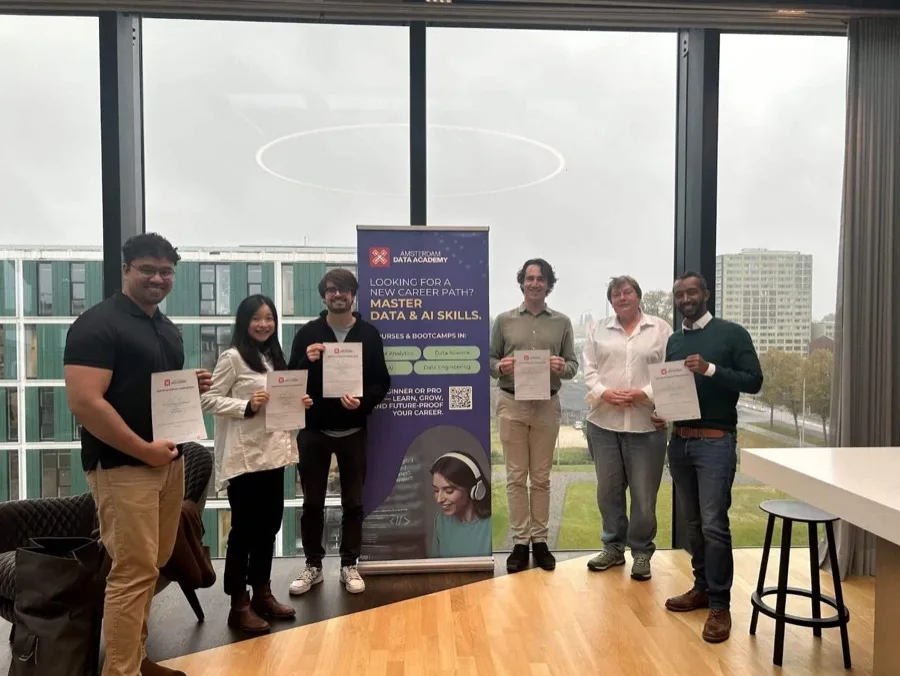
Alumni tell their story
They came from another field and now work with data. This is how it went.
Priyant
From online marketer to data, with the bootcamp and a career coach
Yiselda
Alumna of the Data & Analytics Bootcamp
Questions
No. The courses are about your own work, not about programming or technology.
24 hours of study per course. In a group or with personal training you add three one-hour sessions.
Yes. Teams from one organisation get a tailored proposal, matched to your own practice and invoiced in one go.
A certificate of participation. Each course ends with an assessed final assignment with written feedback. The modules come from our Applied AI & Data Science diploma programme, classified at NLQF Level 6, comparable to bachelor level.
Yes, under conditions. Under the AI Act this counts as high risk. In the course you learn which requirements that brings and how to keep a person in the process.
Both. The assignments cover recruitment, onboarding, development and people analytics; you choose the case that fits your work.
Other fields
Which course fits you or your team?
Not sure whether AI or Data Essentials fits, or want to start with your HR team? In a free 30-minute video call we work out together what fits.